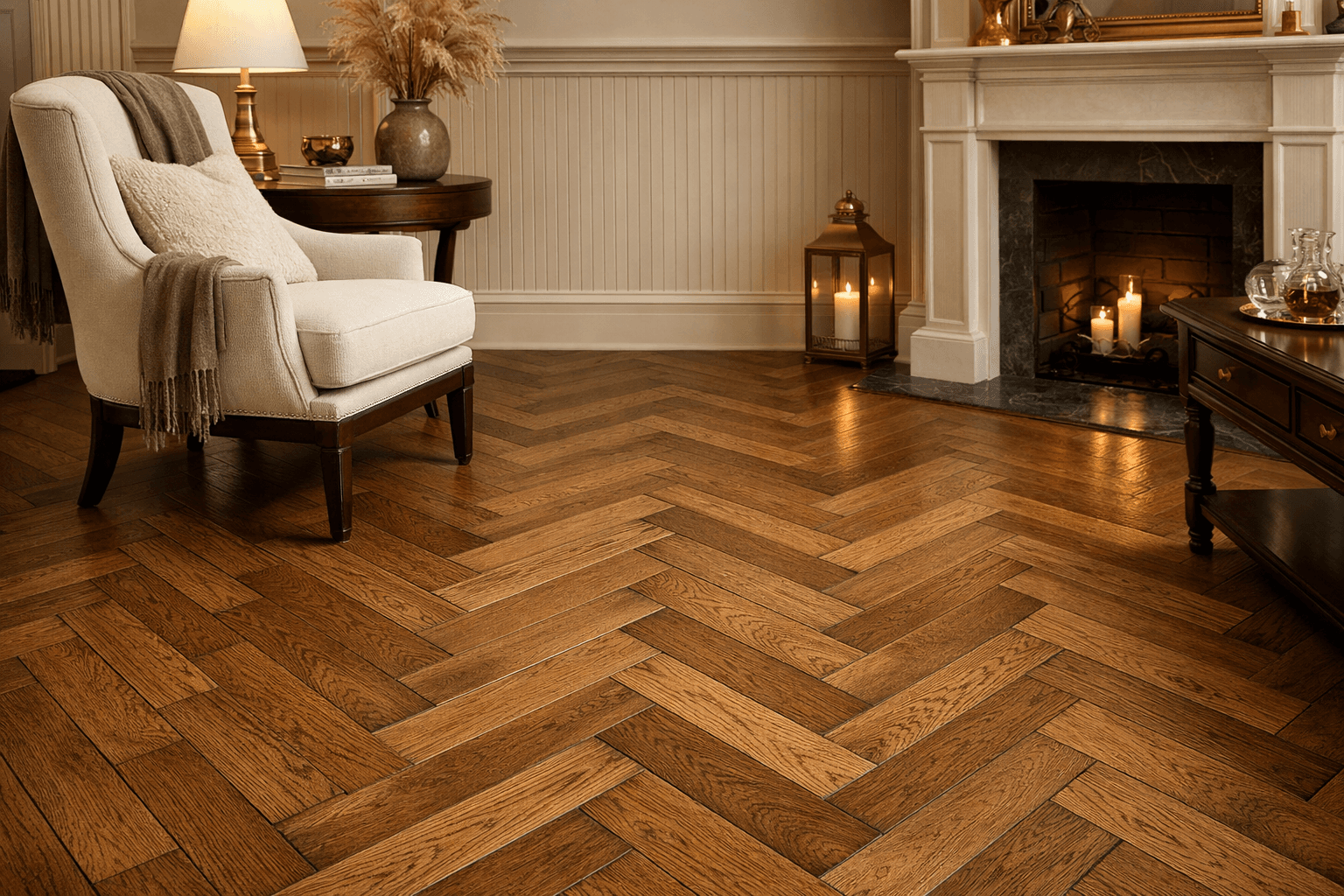
Solid hardwood flooring looks incredible in European homes. In India, it's a gamble. Not because the wood is bad — teak, oak, and walnut are genuinely beautiful materials — but because India's climate treats solid wood very differently than the temperate climates it was designed for. Here is the honest comparison that showrooms won't give you.
What You're Actually Comparing
Solid wood: A single plank of hardwood, 18–22mm thick, dried to 6–8% moisture content at the factory. The entire thickness is one species — teak, oak, walnut, maple, whatever you choose.
Engineered wood: A 2–6mm veneer of hardwood bonded to a cross-ply core of 5–13 layers of eucalyptus, birch, or pine plywood. The top looks identical to solid wood; the structural behaviour is completely different.
The Humidity Problem in India
Solid wood expands when humidity rises and contracts when it drops. In Delhi, humidity can swing from 25% in January to 85% in August — a 60-point swing. That's enough to cause solid wood planks to cup, gap, or buckle if not accounted for precisely. Installations require wider expansion gaps, acclimatisation periods of 2–3 weeks, and humidity-controlled rooms year-round.
Engineered wood's cross-ply construction resists this movement. The alternating grain direction of the plies locks the board against most humidity-driven movement. A well-made engineered board (9+ plies) in Mumbai can behave more predictably than solid wood in Chandigarh — a city that's supposedly "drier" and "safer" for solid wood.
Cost Reality in India (2026)
| Solid Wood | Engineered Wood | |
|---|---|---|
| Material cost | ₹300–800/sqft | ₹140–400/sqft |
| Installation | ₹60–100/sqft (specialist required) | ₹40–70/sqft (click-lock DIY-possible) |
| Sanding/refinishing | Can be done 5–7 times (lifetime product) | 1–3 times depending on wear layer (1.5mm+ preferred) |
| Lifespan in Indian conditions | 20–40 years IF maintained correctly | 15–25 years with normal care |
When Solid Wood Makes Sense in India
Honestly — rarely. The right conditions are: a climate-controlled home (AC + humidifier running year-round), a high-altitude or dry-climate city (Dehradun, Shimla, parts of Rajasthan), and a budget that allows for the 2–3 week acclimatisation period and specialist glue-down installation. In a standard Indian apartment in Mumbai, Delhi, or Bangalore, engineered wood gives you 95% of the aesthetic at 60% of the risk.
The One Area Where Solid Wins
Refinishing. If you want a floor that you can sand back to bare wood and completely re-stain in 20 years — that's solid wood's real advantage. A 20mm solid teak plank can be sanded 6 times over its life. A 2mm engineered veneer can be done once, maybe twice. If you're buying a forever home and want a truly multi-generational floor, solid hardwood's refinishability justifies the premium and the extra care it demands.
Our Recommendation
For most Indian homes: engineered hardwood, 9-ply or more, 2mm+ wear layer. You get the look of real wood with the structural stability that India's climate actually demands. Save solid wood for the one room where you want heirloom quality and you're committed to maintaining it properly — master bedroom of a permanently climate-controlled home is the classic use case.